




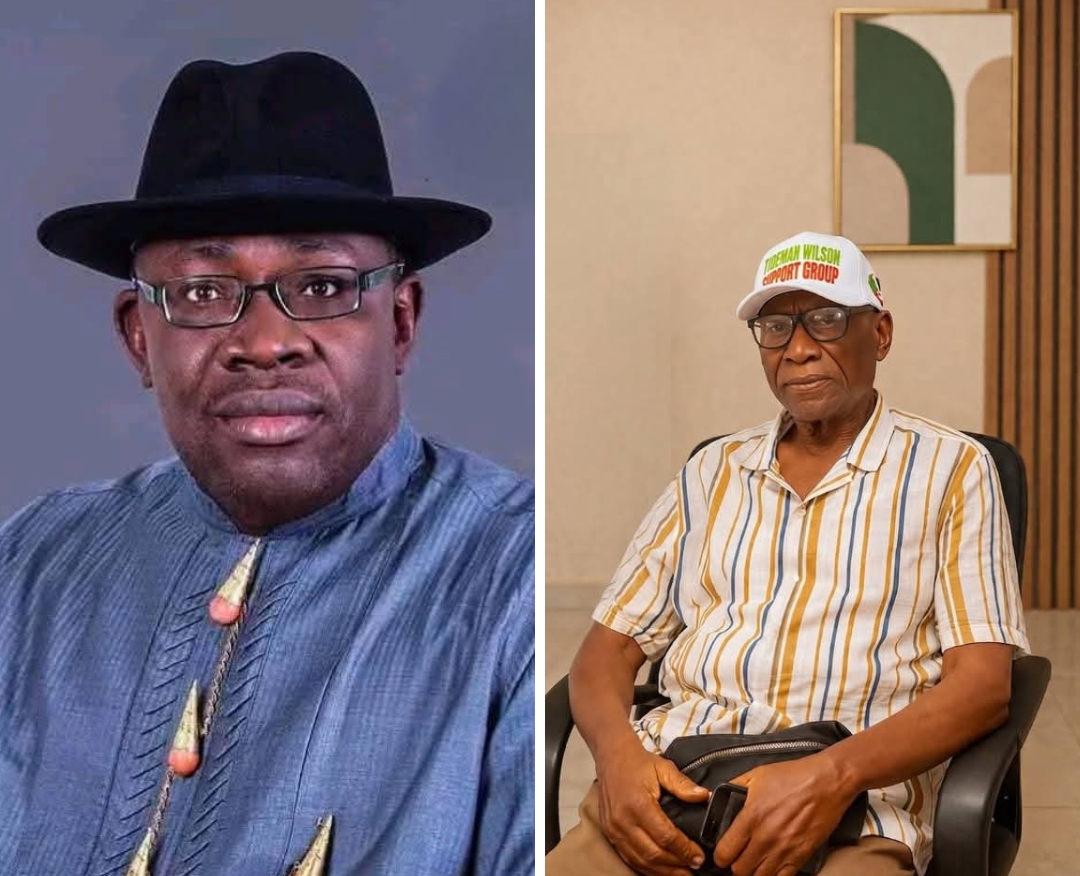
In view of the various speculations and conflicting narratives circulating in the media regarding the reasons behind Elder Fynman Wilson and his son, Felix Wilson, joining the APC, it has become necessary to present our perspective and clarify certain issues.
The Association of Development Initiatives (ADI) undertook a review of the political relationship and history between Senator Henry Seriake Dickson and Elder Fynman Wilson in order to provide context to the ongoing public debate.
To begin with, it is important to recall a part of their shared history. During his Basic Studies in Port Harcourt in 1983, Senator Henry Seriake Dickson resided in the home of the respected statesman, Chief Stanley Oye. Around the same period, Elder Fynman Wilson, following the dissolution of the old Rivers State House of Assembly, also came to the same residence in Port Harcourt.
Those who knew the household at the time recall that the young Dickson willingly assisted in maintaining the home by cleaning the compound and washing vehicles as his own contribution in appreciation of Chief Stanley Oye’s hospitality and kindness.
Shortly thereafter, Senator Dickson enlisted in the Nigeria Police Force, beginning a public service career that would later lead him into politics.
Years later, upon becoming Governor of Bayelsa State, Senator Dickson appointed Elder Fynman Wilson as Special Adviser on Political Matters – one of the most influential political offices in his administration. The position placed Elder Wilson at the centre of government political coordination and significantly elevated his political relevance within Bayelsa State.
From that point onward, Elder Fynman Wilson became one of the major beneficiaries of Senator Dickson’s political goodwill. He was entrusted with strategic responsibilities, appointments, contracts, and leadership opportunities, including serving as Caucus Chairman for Bayelsa West Senatorial District.
As Governor, Senator Dickson also entrusted Elder Wilson with considerable influence over political appointments in Sagbama Local Government Area, reflecting the confidence he reposed in him.
The support extended beyond Elder Wilson himself. Members of his family also benefited from opportunities within his government. His younger brother, Ebi Wilson, serving within the Bayelsa State Civil Service and worked closely with the office of Senator Lawrence Ewhrudjakpo, the former Deputy Governor, during his government was also made possible.
These developments suggest that Senator Dickson consistently supported and empowered Elder Fynman Wilson and members of his family throughout their political journey. From this perspective, it is difficult to sustain the claim that Elder Wilson was solely responsible for building Senator Dickson politically.
Within the Nigeria Democratic Congress (NDC), Elder Fynman Wilson occupied a position of considerable influence in Sagbama and Ekeremor Local Government Areas. Senator Dickson actually allowed him to operate freely as a leader and elder statesman. Fynman Wilson nominated the Sagbama LGA Chairman, the Bayelsa West Senatorial Publicity Secretary, the Bayelsa West Senatorial Vice Chairman, ward executives, and several other party officials.
This level of influence reflected the confidence Senator Dickson placed in him and his determination to ensure Elder Wilson remained respected and politically relevant within the party.
Senator Dickson consistently protected his interests, supported his political will, and provided opportunities for him to contribute meaningfully to the growth of the party.
It is therefore our position that Elder Fynman Wilson had no compelling moral justification for leaving the NDC.
The party’s decision to conduct a swift and transparent democratic primary election, in Dickson’s opinion, should not erase the years of trust, partnership, and political support.
There have also been widespread political discussions suggesting that Elder Fynman Wilson’s decision may have been influenced by considerations beyond the outcome of the NDC primaries. While these remain matters of public speculation and have not been independently verified, they continue to feature prominently in political conversations.
It is publicly known that the Deputy Governor of Bayelsa State, Hon. Peter Akpe, is related to Elder Fynman Wilson. Consequently, some political observers have speculated that discussions regarding alignment with the APC may have predated the NDC primary election. Others have also suggested that, had Felix Wilson, Fynman’s son, secured the NDC ticket, he could subsequently have defected to the APC, thereby strengthening the ruling party’s electoral prospects in the area. These claims are appearing to be true considering the way and manner and excuses given to made them join the APC.
What is on record is that during the NDC primary election, votes cast for Felix Wilson were counted. However, party reports indicate that before the counting process for Hon. Michael Magbisa’s votes could be concluded, the exercise was disrupted by some supporters of Felix Wilson. Those actions raised legitimate concerns about commitment to internal party democracy and the overall success of the NDC.
Ultimately, the assertion that Elder Fynman Wilson made Senator Henry Seriake Dickson politically is, in our considered opinion, inconsistent with the historical record. Rather, the evidence available points to a longstanding relationship in which Senator Dickson consistently supported, promoted, and empowered Elder Fynman Wilson in his political career.
Signed:
Mr. Benjamin Asakeme
President
Association of Development Initiatives (ADI)
